Showing posts with label Williams. Show all posts

Monday, September 20, 2010

Runeson and Affordances

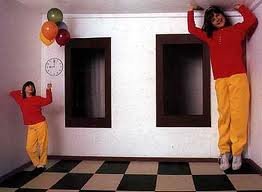
Here is how Runeson describes the information one uses in static viewing of the Ames room in order to perceive a rectangular room.
Geometrically, the chances that an equivalent configuration would occur by random is therefore only in a 100 million and that is for a very simple, barren case. For a room without the size restriction or with furniture and structured surfaces, the chances are many orders of magnitude smaller yet.
Physical constraints. Solid chunks of matter can not be distributed arbitrarily in space, especially not in a gravitational field. Hence, out of the total set of geometrically possible configurations, only a subset can be physically realized (Todd, 1985). The subset that can be realized through more or less natural shaping processes is even smaller. The physical constraints that apply to the manufacture of roomlike enclosures include gravity and other load forces, strength and weight of materials, methods for shaping and joining parts, economy of space, materials, and labor. One must then ask, do prevailing physical and ecological constraints suffice to exclude the kind of room shapes that would be projectively equivalent with normal rooms?  (Runeson, 1988, p. 299).
Part of why I like this is that it seems to me to be talking about the good old-fashion geometry and physics I learned in college and before.  I get that.

But, it also makes me wonder how one fits the talk of affordances and the ecologically meaningful into the story.  Affordances and ecological meaning here seems to me to be superfluous.  So, I don't really see how Runeson needs the kind of thing that Gary describes in comments on this earlier post:
I think the best way to get a grip on ecological information is to forget about the complexities of higher mammalian perception and look at the bacterium as the exemplar of detecting ecological information.

If you put a bacterium in a sucrose solution, the bacterium is able to detect or discriminate the differential sucrose gradients and orient itself such that its propulsion will maximize the exposure to sucrose. For ecological psychology, *this* is the paradigm case of successful perception. The ecological information in this example is the nutritional properties of the sucrose. There is nothing intrinsic to the sucrose molecule that makes it "ecological information" or "nutrition". Rather, it is ecological information only in relation to the nature of the bacterium's specific metabolism. But this doesn't make it "subjective".

Monday, September 13, 2010

I had forgotten about this study

In recent discussions of aperture vision, Gary appears to have been articulating a view according to which studying aperture vision is not doing ecological psychology.

He writes,"So Gibson would respond to Ken by saying that in the aperture experiment, there is mere sensation going on, but no perception, because perception is defined as the discrimination of meaningful ecological information and there is none available in the ambiguity of the aperture experiment."

But, there is this study:
The Distorted Room Illusion, Equivalent Configurations,
and the Specificity of Static Optic Arrays

Sverker Runeson
Uppsala University, Uppsala, Sweden

The distorted room illusion (DRI) and the attendant argument for perceptual ambiguity is critically analyzed from a Gibsonian/ecological point of view. The notions of multiple specification, conflicting information, and perceptual skill are invoked in showing how the ecological approach can accommodate illusion effects that may remain under mobile binocular viewing conditions. Static optic arrays are shown not to be ambiguous. So-called equivalent configurations
are found to be analytic artifacts, appearing when the problem of information is treated in geometrical terms without regard for constraints due to physical and ecological regularities. The relative importance of motion-based and motion-independent information is discussed.
Journal of Experimental Psychology: Human Perception and Performance 1988, Vol. 14, No. 2, 295-304

Meaningless Aperture Vision?

In an earliest post, I wrote " something is going on during episodes of so-called "aperture vision" and a scientist might well want to know what.  So, why not have a scientific study of aperture vision along with a scientific study of "the actual binocular vision system"?

In the comments, Gary wrote the following

What he meant was that mere sensory stimulation falls shorts of *meaningful* perceptual awareness i.e. an awareness of an affordance. It isn't like when you look through an aperture your vision fades to black or anything, *it just doesn't mean anything*. Gibson liked to talk about the Ganzfeld experiments wherein subjects looked at an undifferentiated visual field (you can try this with cut-open pingpong balls; it's fun). When you perceive an undifferentiated visual field (such as when looking at the pure sky), there is *sensory stimulation* but no available *stimulus information* and thus no perception an affordance, which is defined in terms of stimulus information (the information discrimination of which can help effectively regulate your changing relationship with the environment).

So Gibson would respond to Ken by saying that in the aperture experiment, there is mere sensation going on, but no perception, because perception is defined as the discrimination of meaningful ecological information and there is none available in the ambiguity of the aperture experiment.
I hope that clarifies things. 
So, here's a claim: in aperture vision there is no discrimination of meaningful ecological information.

I don't understand why that is true.   Don't the windows, or children, or balloons give me meaningful ecological information? Don't the windows afford something like "see-out-ability"?

And don't the doors in the version of the Ames room belong afford "walk-through-ability?"

Tuesday, September 7, 2010

EC: Wild or Mild?

A while back, Gary Williams was proposing that we should understand EC as something other than a radical claim.  I'm sure that there are non-radical elements and takes on EC.  (Indeed, as I have posted before, I think that edgy ambiguity is almost a modus vivendi of EC.)  For example, it is not radical to claim that the body and environment play an important role in the life of the mind.  If that's all one wants out of extended cognition, then to my mind everyone but Leibniz and a few of his sympaticos is on board.

Do you like your EC mild or wild?

But, there are those who do intend to have EC be a radical claim.  Wilson is one of them:
Locational externalism, environmentalism, and the extended mind thesis are radical forms of externalism in at least two ways. First, they do not rest on claims and intuitions about whether the content of a pair of states of two individuals in different environments (or one individual in two such environments over time) is the same or different, about how particular intentional states are taxonomized, or about the role of the physical or social environments in individuating such states. Instead, they appeal to the nature of psychological processing, to the arbitrariness of the head (or the skin) for bounding cognitive systems, and to what happens in real-life, online cognitive activity in the world. Thus, if the extended mind thesis is true, it is true in virtue of something implementationally deep about cognition, rather than some debatable view of mental content. Second, locational externalism is not simply a view of how we "talk about" or view cognition and the mind-about the epistemology of the mind, one might say-but about what cognition and the mind are-about the ontology of the mind.  (Wilson, 2010, p. 171).

Wednesday, August 11, 2010

My Reply to Fisher is Now Officially in Print

"The Boundaries Still Stand: A Reply to Fisher" in the Journal of Mind and Behavior. 

I've discussed this a bit with Gary Williams here.

Wednesday, August 4, 2010

Gary Williams' "Minds and Brains" Blog

Williams, a grad student at LSU, has a very nice blog, "Minds and Brains," here.  I've found several of his posts interesting and informative, probably because he embraces much of the Heideggerian, Gibsonian, picture that I often find baffling.

We have been discussing Noë's enactivism here.  There are also links to a forthcoming paper of mine and another soon-to-exist link to a forthcoming paper by Nivedita Gangopadhya.