So, I have a few more posts on Runeson's paper for the next few days. It's pretty interesting, but far from answering all my questions.
I'll get back to "Meaning making ..." eventually.
Monday, September 13, 2010


I had forgotten about this study
In recent discussions of aperture vision, Gary appears to have been articulating a view according to which studying aperture vision is not doing ecological psychology.
He writes,"So Gibson would respond to Ken by saying that in the aperture experiment, there is mere sensation going on, but no perception, because perception is defined as the discrimination of meaningful ecological information and there is none available in the ambiguity of the aperture experiment."
But, there is this study:
Journal of Experimental Psychology: Human Perception and Performance 1988, Vol. 14, No. 2, 295-304The Distorted Room Illusion, Equivalent Configurations,
and the Specificity of Static Optic Arrays
Sverker Runeson
Uppsala University, Uppsala, SwedenThe distorted room illusion (DRI) and the attendant argument for perceptual ambiguity is critically analyzed from a Gibsonian/ecological point of view. The notions of multiple specification, conflicting information, and perceptual skill are invoked in showing how the ecological approach can accommodate illusion effects that may remain under mobile binocular viewing conditions. Static optic arrays are shown not to be ambiguous. So-called equivalent configurations
are found to be analytic artifacts, appearing when the problem of information is treated in geometrical terms without regard for constraints due to physical and ecological regularities. The relative importance of motion-based and motion-independent information is discussed.
Meaningless Aperture Vision?
In an earliest post, I wrote " something is going on during episodes of so-called "aperture vision" and a scientist might well want to know what. So, why not have a scientific study of aperture vision along with a scientific study of "the actual binocular vision system"?
In the comments, Gary wrote the following
What he meant was that mere sensory stimulation falls shorts of *meaningful* perceptual awareness i.e. an awareness of an affordance. It isn't like when you look through an aperture your vision fades to black or anything, *it just doesn't mean anything*. Gibson liked to talk about the Ganzfeld experiments wherein subjects looked at an undifferentiated visual field (you can try this with cut-open pingpong balls; it's fun). When you perceive an undifferentiated visual field (such as when looking at the pure sky), there is *sensory stimulation* but no available *stimulus information* and thus no perception an affordance, which is defined in terms of stimulus information (the information discrimination of which can help effectively regulate your changing relationship with the environment).
So Gibson would respond to Ken by saying that in the aperture experiment, there is mere sensation going on, but no perception, because perception is defined as the discrimination of meaningful ecological information and there is none available in the ambiguity of the aperture experiment.
I hope that clarifies things.So, here's a claim: in aperture vision there is no discrimination of meaningful ecological information.
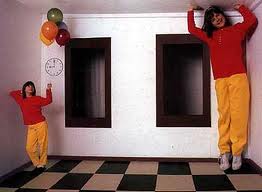
I don't understand why that is true. Don't the windows, or children, or balloons give me meaningful ecological information? Don't the windows afford something like "see-out-ability"?
And don't the doors in the version of the Ames room belong afford "walk-through-ability?"

Saturday, September 11, 2010
Friday, September 10, 2010
Active Cognition Arguments
Active cognition arguments are so called because they all appeal to the active exercise of cognitive capacities in the real world ...The first thing to be on the look out for in what follows, I think, is an instance of the coupling-constitution fallacy. When an argument begins by drawing attention to the "important" contribution some bodily or environmental process makes to cognition, one can expect the fallacy to arrive sooner or later. Similarly, when an argument begins by drawing attention to how one actively exercises one's cognitive capacities in the world, one is drawing attention to the way one is causally connected to the world, hence probably lining up to commit some version of the coupling-constitution fallacy.
These arguments all focus on determinate forms of a particular cognitive ability (e.g., memory, attention, problem solving) as they are exercised by individual agents. They view the integration of individuals with both their biological and artificial environments as critical to their status as cognitive agents with these particular capacities. With this focus on actual agents and the abilities they act on, active cognition arguments try to preempt the objection that "the extended mind" is merely a conceptual possibility or a far;on de parler. The chief aim of active cognition arguments has been to show directly that much of cognition as we know it is extended; the real question for their proponents is just which aspects of cognition are extended, and in what ways. (Wilson, 2010, p. 172).
But, that aside, it is important to note that Wilson, at least, is not merely arguing that EC is possible. He wants to argue that something closer to the view that EC is a prevalent feature of the human condition ... kind of like saying that we are natural born cyborgs.
Thursday, September 9, 2010
What's Wrong with Rhodopsin?
Looking up info for another blog post, I see that Adams and Aizawa gave another example trying to indicate what the coupling-constitution distinction might be (rather than trying to give a philosophical account of what the distinction might be). The process is the isomerization of rhodopsin upon photon capture.
Both Rockwell, (2005), and Hurley, (forthcoming), express skepticism about the coupling-constitution distinction, although neither express serious reasons for doubting the distinction. There is, it seems to us, some reason for their suspicion, namely, that it is hard to make out this distinction for the case of cognition. What is the difference between things that merely cause cognitive processes and things that constitute cognitive processes? If we restate the question slightly, the source of the difficulty should be clear. What, we should ask, is the difference between things that merely cause cognitive processes and things are cognitive processes? The problem lies in the uncertainty about what exactly cognitive processes are. In support of this diagnosis, consider a case where we do have a well-established theory of what a given type of process is. Consider again the process of nuclear fission. The process of nuclear fission is constituted by the process of a large atomic nucleus being broken into smaller atomic nuclei. Nuclear fission can be caused by bombardment of the nucleus with neutrons. The process of neutron bombardment causes nuclear fission, but does not constitute nuclear fission. Consider the isomerization of the retinal component of rhodopsin in the human eye. This process is constituted by a change in the molecular structure of the retinal component from 11-cis retinal to all-trans retinal. It is typically caused by absorption of a photon. Now the distinction is intuitively clear, although possibly difficult to explicate philosophically. Where we have a clear theory of the nature of a process, we have a very fair idea of the difference between what might cause it and what might constitute it. (Adams & Aizawa, 2008, p. 101).They object to the nuclear fission example because "the literal description of nuclear fission is mathematical and incorporates no such simple intuition". (Ross and Ladyman, 2010, p. 163). Ok. So, what's the problem with the rhodopsin example?
Another slow news day in Shreveport ...
Here in the Shreveport Times, they can publish a blurb on a philosophy professor and give the copy editor the day off.
Wednesday, September 8, 2010
"Meaning making ..." can wait
Over the past few days, I've been enjoying some great exchanges on ecological psychology with Andrew Wilson (Thanks, Andrew!), which is consuming all of my usual blogging time and more. That and teaching and the usual work tell me I should put my "Meaning making ..." posts on hold for a bit. I know everyone is crying.
Gibson on Aperture Vision
In The Ecological Approach to Visual Perception, Gibson speaks rather disparagingly of what he calls "aperture vision":

Ok. So, grant that aperture vision is not genuine vision as Gibson conceives it. Concede, just for the sake of argument, that only the eye considered as a fixed camera can be deceived and that the actual binocular visual system cannot. Still, something is going on during episodes of so-called "aperture vision" and a scientist might well want to know what. So, why not have a scientific study of aperture vision along with a scientific study of "the actual binocular vision system"?
Just be sure, I guess we can add, not to simply assume that what one learns from aperture vision applies to "genuine vision". What's wrong with that?
The eye is easily deceived, and our faith in the reality of what we see is therefore precarious. For two millenniums we have been told so.
The purveyors of this doctrine disregard certain facts. The deception is possible only for a single eye at a fixed point of observation with a constricted field of view, for what I called aperture vision. This not genuine vision, not as conceived in this book. Only the eye considered as a fixed camera can be deceived. The actual binocular visual system cannot. (Gibson, 1979, p. 281)

Ok. So, grant that aperture vision is not genuine vision as Gibson conceives it. Concede, just for the sake of argument, that only the eye considered as a fixed camera can be deceived and that the actual binocular visual system cannot. Still, something is going on during episodes of so-called "aperture vision" and a scientist might well want to know what. So, why not have a scientific study of aperture vision along with a scientific study of "the actual binocular vision system"?
Just be sure, I guess we can add, not to simply assume that what one learns from aperture vision applies to "genuine vision". What's wrong with that?
Tuesday, September 7, 2010
What's the "trick" here?
In some comments over at "Notes from Two Scientific Psychologists" here and here, I have been wondering about the Gibsonian claim that "Only the eye considered as a fixed camera can be deceived. The actual binocular visual system cannot. (Gibson, 1979, p. 281)" and that "all illusions are tricks". I am curious about the snake illusion and certain auditory illusions. What's the trick in these cases?
But certain cases of amodal completion raise the same problem. The illusion is that some occluded object looks circular, when it is not. What's the "trick" in these cases?
Now, I know that Gibsonians often worry about 2D drawn illusions, but at least some of the problematic amodal completion cases seem not to depend on the 2D character of the illusion. Readers can verify this for themselves by creating circular "tiles" with parts cut out and see for themselves.
Seeing, however, as I learned how to use Windows Moviemaker for my appearance on Philosophy TV, I thought I would venture to add some video showing the "tile" I made. The video is not meant to replace doing the demo for one's self, but it was fun for me to make. How many philosophers add video to their blogs? (It's a good thing I'm not dreaming of going to film school, but that's another matter.)
Subscribe to:
Posts (Atom)